Nuclear-Derived Sustainable Aviation Fuel (SAF) is SAF produced using nuclear energy as the low carbon energy input. In practice this usually means synthetic SAF made via a Power to Liquids (PtL) pathway. Water is split to make hydrogen, carbon dioxide is supplied as a feedstock and those molecules are converted into jet fuel. The nuclear contribution is the energy that makes the whole chain reliable, scalable and consistently low carbon.
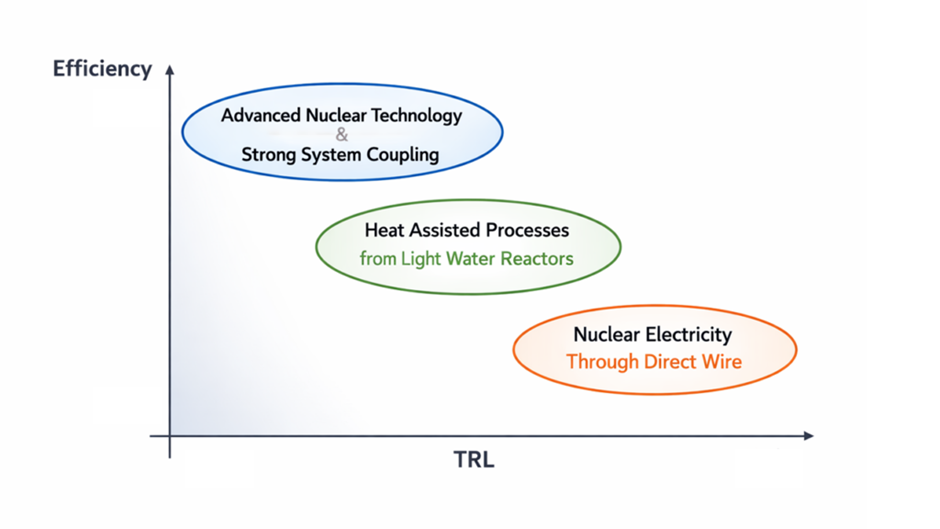
A useful way to think about nuclear SAF is as a spectrum of integration. At one end nuclear supplies electricity only. In the middle nuclear supplies electricity plus usable heat. At the far end nuclear energy and the SAF plant are engineered as a coupled system that shares utilities and controls to behave like a single high availability industrial asset.
Why is nuclear energy a good fit for SAF?
Most PtL SAF processes are electricity led industrial systems. They are capital intensive and perform best when they run steadily. Frequent ramping, pauses and restarts tend to reduce annual output, increase unit cost and introduce operational risk. Nuclear generation has a structural advantage because it is firm and predictable. It is designed to operate continuously for long periods and that lines up with the operational needs of PtL plants.
There is also a whole system efficiency consideration. Nuclear energy is a thermal technology first. Converting nuclear reactor heat to electricity and then using that electricity to recreate process that could be complete using heat, discards useful thermal energy. If the SAF plant can use some of the reactor’s heat directly, you get more useful process energy per unit of nuclear output, and you reduce the amount of electricity that has to be bought, transformed and distributed around the site.
The basic PtL route behind nuclear derived SAF
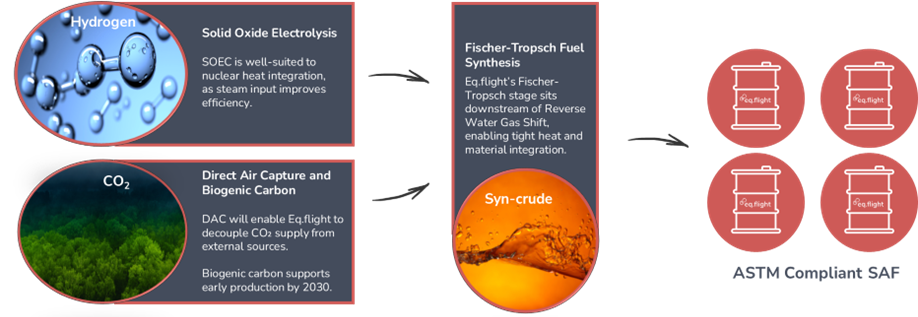
A typical nuclear enabled PtL SAF pathway looks like this
- CO2 supply – CO2 can come from Direct Air Capture or external sources.
- Hydrogen production – Water is converted to hydrogen using electrolysis.
- Syngas production – CO2 and hydrogen are converted into a syngas mixture using reverse water gas shift.
- Fuel synthesis – Eq.flight uses Fischer-Tropsch synthesis to convert syngas into hydrocarbon chains.
- Upgrading and finishing – The raw product is upgraded and distilled into synthetic blend component ready to be mixed with conventional fuel to power an aircraft.
The integration curve for nuclear derived SAF
- Nuclear energy as an electricity source only
The SAF plant runs entirely on electricity, and that electricity is provided by nuclear generation. The plant may be grid connected or directly wired, but the key point is that nuclear energy is providing low carbon electrons.
- Nuclear energy as an electricity source plus a heat source
The SAF plant takes nuclear electricity and also takes useful heat, typically as low pressure steam or hot water. This does not require extremely high temperature reactors. Conventional nuclear reactor secondary circuit steam and condenser adjacent heat can be valuable for many process duties.
- Fully integrated nuclear derived SAF
The nuclear plant and the SAF plant are designed as a coupled energy system. Electricity and heat offtake are engineered together, and the interface is designed to support high availability and predictable operations.

Nuclear derived SAF is not a single technology. It is an approach to making synthetic aviation fuel that takes advantage of nuclear energy’s reliability and its ability to provide both power and heat. The more closely the fuel plant is integrated with nuclear energy, the more benefits you can capture. Higher utilisation, lower cost pressure, fewer operational interruptions and more confidence in delivering volumes on schedule.
For Eq.flight the primary objective is to prove that a nuclear-integrated PtL plant can operate as a steady industrial asset. That means designing around continuous energy availability, making heat do as much work as possible and engineering the interfaces so the whole system behaves predictably over long operating periods.